Stand in any pet store aisle and the bags shout at you. Ancient grains. Wild caught fish. Recipes inspired by wolves. Turn one around, though, and the small print on the back reads like a chemistry exam. It is not one. Almost everything on that panel follows a set format. Learn what each part means and you can judge a food in about a minute.
That format traces back to AAFCO, the Association of American Feed Control Officials, a membership body of state and federal feed regulators. AAFCO writes the ingredient definitions, nutrient profiles and model label rules most states adopt and enforce. What it does not do is approve, test or certify any food, so distrust bags that hint at an AAFCO endorsement.
Here is the order to read one in, most important sentence first.
The Parts of a Dog Food Label at a Glance
US label rules call for eight basic items on every dog food package: three on the front panel, the rest on the back or side.
- Brand and product name
- The species the food is made for (dog food, for dogs)
- Net quantity statement, how much food is in the package
- Guaranteed analysis
- Ingredient list
- Nutritional adequacy statement
- Feeding directions
- Name and address of the manufacturer or distributor
Start with item six. It answers the biggest question: can this food be your dog’s whole diet? Calories get their own section below.
The AAFCO Nutritional Adequacy Statement
The nutritional adequacy statement is one sentence near the ingredient list, and it is the most important line on the bag. It tells you whether the food counts as a complete diet, and which dogs it is complete for. Foods earn the claim in one of two ways.
One pattern reads: “Animal feeding tests using AAFCO procedures substantiate that this food provides complete and balanced nutrition.” That means real dogs ate the food in AAFCO protocol trials and stayed healthy on it.
The second pattern reads: “This food is formulated to meet the nutritional levels established by the AAFCO Dog Food Nutrient Profiles.” That means the recipe was checked against AAFCO’s nutrient minimums and maximums on paper and in the lab, with no feeding trial.
Both routes are legitimate: trials prove dogs can digest and use the nutrients, while formulated foods rely on recipe math.
Then match the named life stage to your dog:
- Growth covers puppies.
- Gestation and lactation covers pregnant and nursing mothers.
- Adult maintenance covers grown dogs only, never a puppy.
- All life stages means the food meets the strictest standard, the growth and reproduction profile, so it suits puppies and adults alike. It tends to run richer, which matters if your adult gains weight easily. Some add wording about growth of large size dogs (adults of 70 pounds or more).
Now the trap. If the statement says the product is “intended for intermittent or supplemental feeding only,” it is not a complete diet, whatever the front of the bag suggests. That wording belongs on treats and toppers, not dinner.
AAFCO’s own guide to reading pet food labels covers the official version.
The Ingredient List: Read It Like a Recipe
Ingredients are listed in order by weight, heaviest first, by what goes into the mix before cooking.
Why the first ingredient can mislead
Fresh chicken is roughly two thirds water. Once it cooks off, the chicken left behind can contribute less protein than its top spot suggests. It is not a scam, but the first spot is partly a water spot. A named meat meal, such as chicken meal, is weighed with most water and fat removed, so it delivers more protein per pound.
Named versus generic ingredients
“Chicken,” “beef” and “salmon” name the species. Generic terms like “meat by-products” or “animal fat” do not. Named ingredients tell you what your dog is eating, which matters when you must avoid one protein. By-products are not automatically poor quality, though: the term covers parts such as organ meats, some of them genuinely nutritious. The drawback of generic names is that the source can shift from batch to batch.
Watch for ingredient splitting
A recipe can split one ingredient into smaller entries so each drops down the list. Peas, pea fiber and pea protein each weigh less than the meat, so each sits lower, even when the pea parts together would outweigh it. When forms of one plant cluster in the top half of the list, read them as a group.
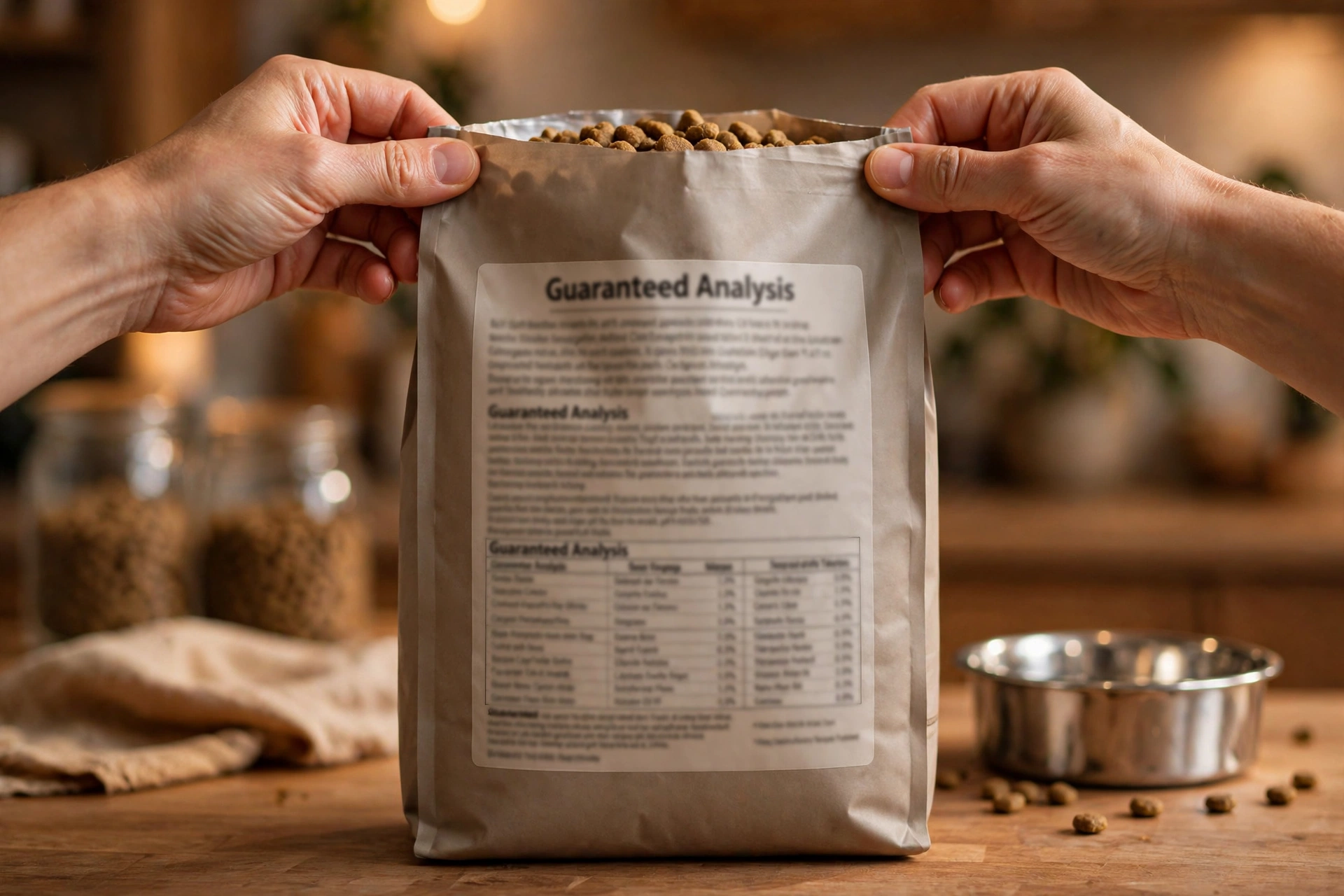
The Guaranteed Analysis: Minimums and Maximums, Not a Recipe
The guaranteed analysis is the small table of percentages, and guaranteed is the key word. These numbers are legal limits, not an exact breakdown of the recipe. Every label must guarantee at least four things:
- Crude protein, a minimum
- Crude fat, a minimum
- Crude fiber, a maximum
- Moisture, a maximum
“Crude” is not a quality warning. It is the name of the lab method behind the number.
How to compare wet and dry food fairly
All four numbers are given “as fed,” water included. That alone makes wet food look weaker than kibble. To compare fairly, convert both to a dry matter basis: divide the nutrient percentage by what remains after the moisture comes out.
A simple example with round numbers: a canned food lists 10 percent protein and 75 percent moisture. The dry part is 25 percent of the food, so its dry matter protein is 10 divided by 25, or 40 percent. A kibble lists 26 percent protein and 10 percent moisture, so 26 divided by 90 is about 29 percent. The can that looked low in protein is actually the higher protein food.
Feeding Directions and the Calorie Statement
The calorie content sits nearby, stated as kilocalories per kilogram (kcal/kg) and kilocalories per cup or per can. The per cup figure is the practical one: it tells you the energy in each scoop, and two foods filling the same cup can differ by a hundred calories.

The feeding directions give a daily amount by dog weight. Treat it as a starting estimate only: it cannot account for your dog’s age, build or activity. Feed it for two or three weeks, then judge by your dog. You should feel ribs under a thin layer of fat and see a waist from above. Adjust in small steps.
Red Flags and Marketing Words That Mean Very Little
The front of the bag is advertising, and its favorite words often carry no legal weight. “Premium,” “super premium,” “gourmet” and “holistic” have no official definition in pet food rules. A recipe can wear all four and still meet only the same minimums as the plainest bag.
“Natural” is the partial exception: AAFCO does define it. The ingredient must come from plant, animal or mined sources and cannot be made through a chemically synthetic process, barring narrow exceptions like synthetic vitamins and minerals. That definition covers how an ingredient was produced, not how nutritious the food is. The same logic applies to cat food, as our guide to choosing the best natural cat food shows.
“Grain free” means only that the recipe contains no grain ingredients. It does not mean low carb, since peas, lentils or potatoes take the grains’ place, and it does not mean better. The FDA has spent years investigating a possible link between certain diets, many grain free, and dilated cardiomyopathy, a heart condition in dogs, and the science is still unsettled. Our explainer on what grain free dog food really means has the fuller picture.
The one phrase with real weight is “complete and balanced,” and only inside the nutritional adequacy statement, backed by an AAFCO profile or feeding tests. Everything else up front is decoration.
Your 60-Second Label Checklist
In the aisle, run these steps in order.
- Find the nutritional adequacy statement on the back. If a main food has none, move on.
- Check the life stage against your dog: growth, gestation and lactation, adult maintenance or all life stages.
- If it says intermittent or supplemental feeding only, treat it as a treat or topper, not dinner.
- Read the first ingredients. Are the protein sources named?
- Scan for one plant ingredient split into several names.
- Comparing wet with dry? Convert both to a dry matter basis first.
- Check the calories per cup against the feeding amount and your dog’s shape.
Frequently Asked Questions
Does AAFCO approve or certify dog food brands?
No. AAFCO does not approve, test or certify any pet food or brand. It writes the nutrient profiles, ingredient definitions and model rules states use to regulate pet food. The adequacy statement on a bag is the manufacturer’s claim, not an AAFCO seal.
Is a food that passed feeding trials better than one that was formulated?
Not automatically. A feeding trial shows real dogs stayed healthy on the food, so its nutrients are proven usable. A formulated food is verified on paper and in the lab. Both support a complete and balanced claim, and the wording tells you which route was used.
Why does the guaranteed analysis only list four nutrients?
Those four are the minimum the rules demand. When a bag claims another nutrient, glucosamine or omega 3s say, that one must be guaranteed too. The rest are covered by the nutrient profile behind the adequacy statement, printed or not.
My dog’s food says “for all life stages.” Is that best for an adult dog?
It means the food meets the demanding growth and reproduction profile, so it covers puppies and adults. It also runs richer in calories than an adult maintenance food, more than a quiet senior needs. Match the life stage to your dog instead.
How can two foods with similar protein percentages be so different?
Because that percentage is measured as fed, water included. A canned food at 10 percent protein and 75 percent moisture carries more protein per bite of real food than a 26 percent kibble once the water comes out of both. Convert to dry matter before judging either one.
Still torn between two foods that pass the checklist? Our guide on how to choose a vet recommended dog food covers the questions worth asking a manufacturer, and the FDA’s pet food pages explain how labeling is policed. Back panel first, front panel last.
This article is general information about reading pet food labels, not veterinary advice. For advice on your own dog’s diet, ask your veterinarian.